
Product
Gauge
Optimal thresholds for quantum error correcting codes.
What is Gauge
Gauge is a Python package that computes the optimal error threshold for any quantum error correcting code and noise model. It is part of the Plaquette family of tools, extending Plaquette’s architecture simulation capabilities with theoretical threshold analysis.
The threshold Gauge computes is not the threshold of a specific decoder. It is the theoretical ceiling: the maximum error rate below which any decoder could, in principle, drive the logical error rate to zero by scaling up the code. Gauge computes this ceiling by mapping the decoding problem onto a statistical mechanical spin model, then using Monte Carlo simulation to find the phase transition that marks the boundary between correctable and uncorrectable regimes.
How it works
Gauge maps the decoding problem onto a statistical mechanical spin model.
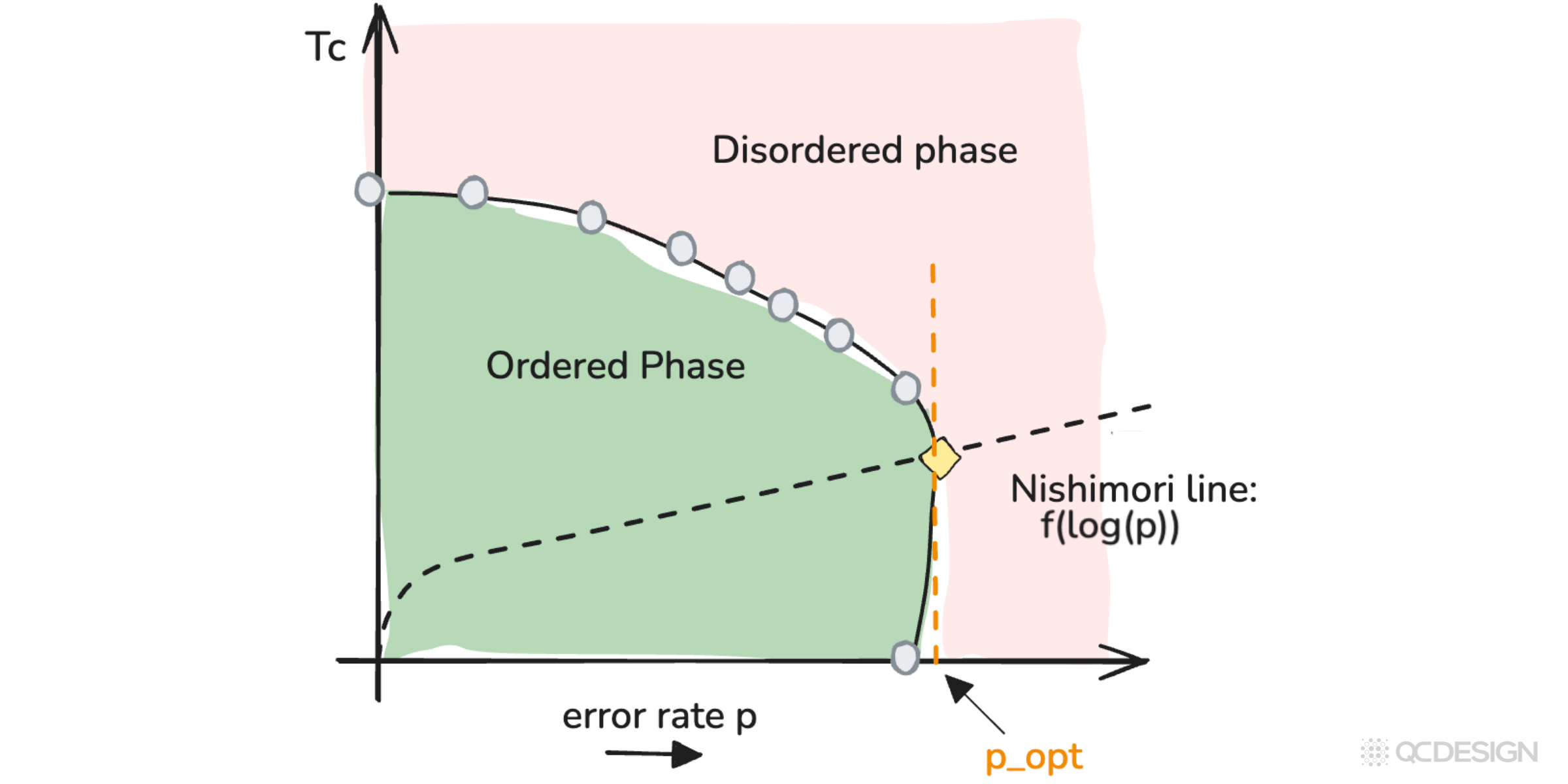
The physical error probabilities are wired into the model’s couplings through the Nishimori conditions, which ensure the partition function directly gives the probability of each error class. The optimal threshold is the phase transition in this model: where the phase boundary intersects the Nishimori line.
Who uses Gauge
Quantum hardware teams, QEC researchers, decoder developers, and anyone else working on fault-tolerance development.
What they use it for
Gauge tells you the best any decoder could do on your code and noise model, answering the question: is the gap between your current decoder and the optimal threshold worth closing with a better decoder, or do the code or hardware need to be improved? Gauge gives you that answer before you commit resources to either direction.
It supports a growing range of quantum error correction codes and noise models. New code families are added regularly, and anything not yet in the built-in library can be defined directly from stabilizers. The Monte Carlo engine runs 100 times faster than those reported in the literature, making it practical for real architectural studies rather than toy examples.
Gauge vs. Plaquette
Gauge and Plaquette are complementary tools. Plaquette tells you the threshold your decoder achieves today. Gauge tells you the theoretical ceiling. Together, they show how much room is left and where to focus next.
Get started
If you’re building or scaling quantum hardware, get in touch to discuss licensing or book a demo.
Not ready yet? Join our practitioners mailing list to be notified when we release new features or publish technical content.